
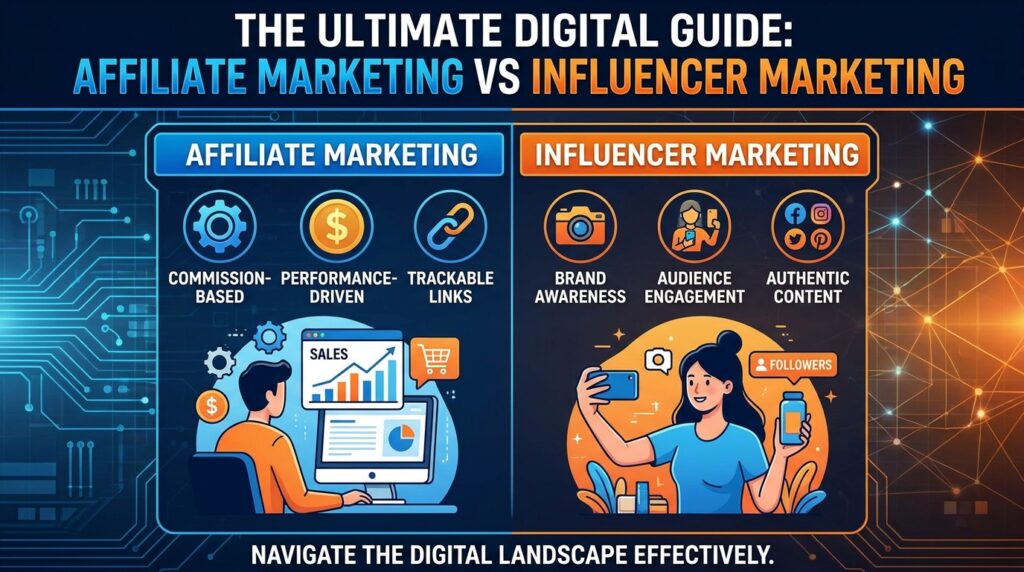
The Ultimate Digital Guide: affiliate marketing vs influencer marketing
In the modern digital era, businesses are constantly exploring innovative avenues to expand their reach, build brand loyalty, and drive consistent sales. A frequent dilemma faced by many marketing professionals, startup founders, and established brand owners is deciding between two incredibly powerful digital strategies. This brings us to the ongoing debate of affiliate marketing vs influencer marketing. To make an informed, data-driven decision for your business, it is absolutely essential to dive deep into how each distinct model operates. Understanding the intricate nuances of affiliate marketing vs influencer marketing is often the key to unlocking exponential business growth. Both of these strategies effectively leverage third-party individuals to promote products to consumers, but their execution and compensation structures differ vastly. If you want to maximize your return on investment, you must analyze affiliate marketing vs influencer marketing closely. Let us explore the fundamental differences.
Defining the Core: affiliate marketing vs influencer marketing
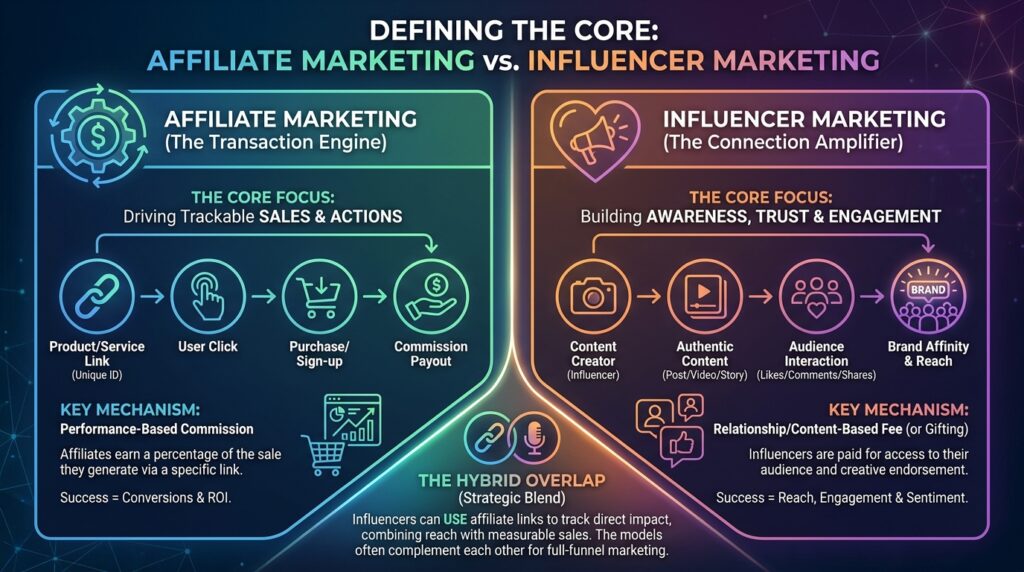
When we break down the fundamental mechanics of affiliate marketing vs influencer marketing, the differences in their operational foundations become quite clear. The former is an entirely performance-based marketing structure. In this setup, partners earn a specific financial commission only when their direct promotional efforts result in a confirmed sale or a predefined business action. It is a highly transactional relationship focused strictly on the bottom line. Conversely, examining the other side of affiliate marketing vs influencer marketing reveals a model focused much more heavily on widespread brand awareness and authentic audience engagement. Content creators are typically paid a negotiated flat fee upfront to creatively feature a product and share it with their dedicated social media followers, regardless of the immediate direct sales generated on that specific day. This fundamental distinction is perhaps the most critical factor when comparing affiliate marketing vs influencer marketing for your upcoming quarterly marketing campaigns. Brands that want guaranteed sales conversions and minimal risk lean one way, while those seeking massive visibility and cultural relevance lean the other. Therefore, thoroughly analyzing affiliate marketing vs influencer marketing helps you directly align your chosen promotional strategy with your specific short-term and long-term corporate objectives properly.
Compensation Models in affiliate marketing vs influencer marketing
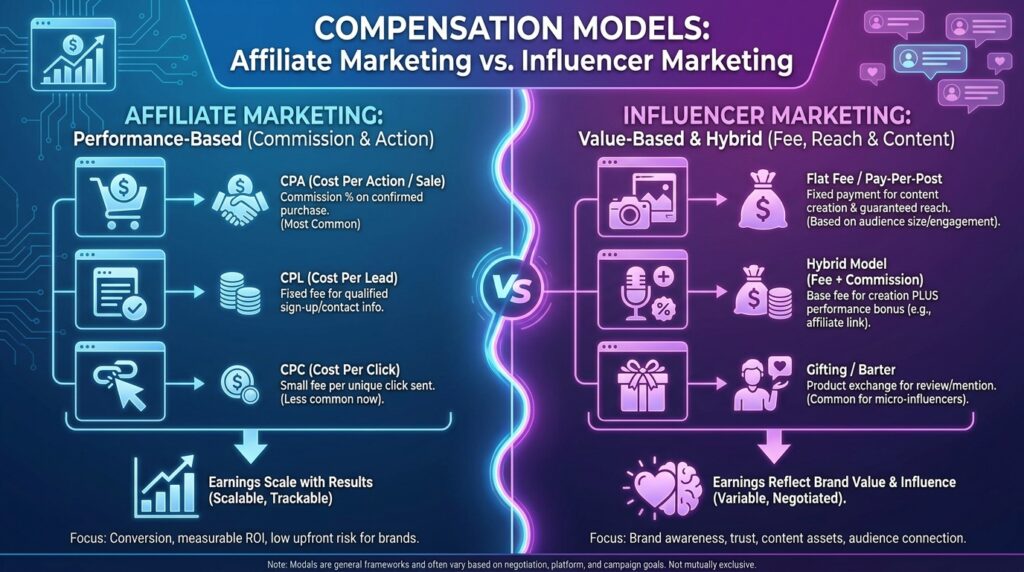
Financial planning and budget allocation are crucial elements for any successful digital campaign, which is exactly why the underlying cost structure in affiliate marketing vs influencer marketing matters immensely to chief marketing officers. In a traditional performance-based setup, the financial risk to the brand is exceptionally low. You only pay out funds when tangible, trackable revenue is generated by the partner, making it a highly cost-effective approach. However, when evaluating the complex financial aspects of affiliate marketing vs influencer marketing, you must recognize that social media creators require a substantial upfront investment before any content is even produced. You are actively paying for their unique creative talent, high-end production quality, and direct access to their highly engaged audience. This stark contrast in payment structures and financial risk is exactly why the debate surrounding affiliate marketing vs influencer marketing continues to dominate industry conferences globally. Smaller brands with exceptionally tight budgets might prefer a strictly commission-based route, ensuring they only spend money when they actually make money. Established brands might find the upfront costs completely justified. Ultimately, your available marketing budget will heavily dictate your stance on affiliate marketing vs influencer marketing entirely.
Audience Trust within affiliate marketing vs influencer marketing
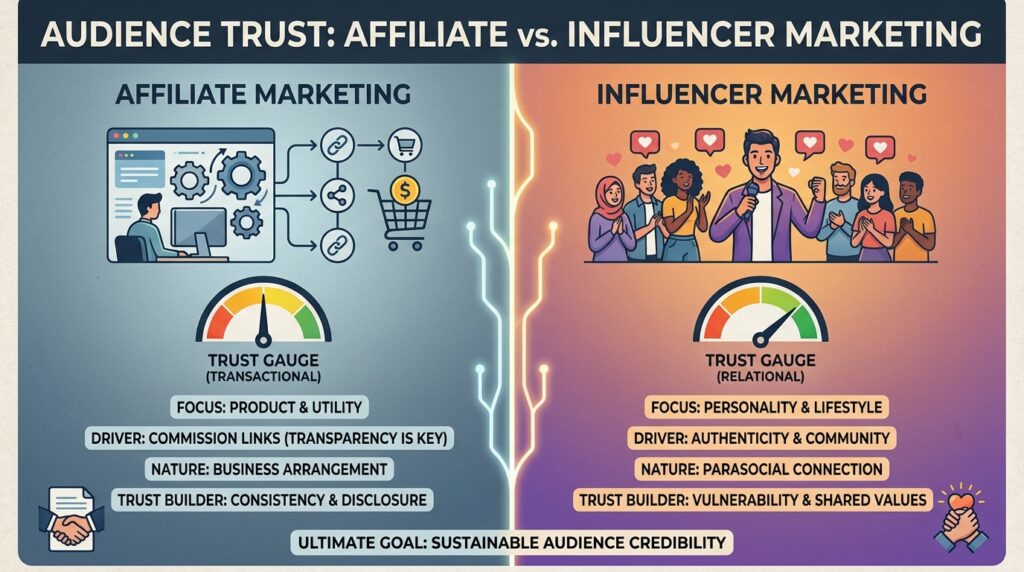
Another highly pivotal factor to consider when designing a marketing funnel is the psychological relationship between the promoter and the end consumer. When looking closely at the audience dynamics of affiliate marketing vs influencer marketing, the level of existing trust and intimacy varies significantly. Many performance-based partners rely heavily on search engine optimization or digital coupon sites to capture consumer traffic. This often means the buyer might not have any strong personal connection with the publisher; they are simply looking for a discount code before checking out. Contrastingly, a foundational element of affiliate marketing vs influencer marketing is the powerful parasocial relationship that digital creators build with their dedicated followers over years of posting. People follow these creators because they genuinely like their distinct personality, deeply trust their purchasing opinions, and highly value their specific niche expertise in select topics. Thus, a direct product recommendation from a trusted creator carries more weight. Understanding this psychological aspect is absolutely vital when carefully studying affiliate marketing vs influencer marketing for your brand.
Tracking Success in affiliate marketing vs influencer marketing
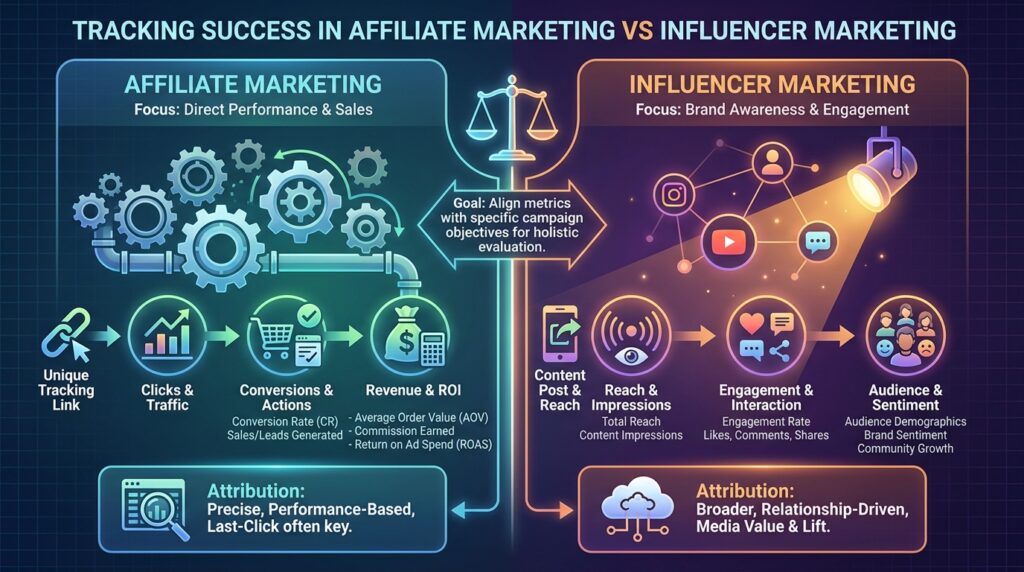
Measuring the precise effectiveness and exact return on investment of your marketing efforts is completely non-negotiable in modern business. The analytical side of affiliate marketing vs influencer marketing provides entirely different sets of data and unique measurement challenges. Traditional performance programs are deeply integrated with tracking software, providing businesses with precise, detailed metrics on link clicks, overall conversion rates, and exact customer acquisition costs. Every single marketing dollar is meticulously tracked directly to a specific custom link, leaving no room for ambiguity or doubt. However, when looking at creator campaigns, they are sometimes much harder to measure purely in immediate, direct sales numbers. While brands can certainly utilize custom promo codes and trackable vanity links, much of the true, long-lasting value comes from elevated brand search volume. Choosing the right path ultimately depends entirely on whether your brand prioritizes immediate, trackable sales data or broader, long-term equity and cultural impact within your specific market sector and target demographic profile
Conclusion: Making The Right Choice

To thoroughly summarize this comprehensive digital overview, both of these robust digital promotional strategies offer immense value when executed correctly. The optimal choice for your specific enterprise will naturally depend on your current financial resources, your overarching corporate goals, and your desired timeline for achieving measurable results. By carefully evaluating the distinct payment structures, the underlying audience trust dynamics, and the varying analytical tracking capabilities discussed above, you can successfully build a highly resilient, future-proof marketing ecosystem that consistently drives profitable growth and elevates your brand above competitors in today’s crowded marketplace.